
The Best Kokanee Dodger: Complete Guide to Trigger More Bites

Here's the truth most anglers don't realize: there is no single "best kokanee dodger" that works everywhere, every time. The best kokanee dodger is the one matched to your exact conditions: depth, trolling speed, light penetration, and how the fish are behaving that day.
Kokanee salmon are one of the most technically demanding freshwater targets out there. In our Complete Kokanee Trolling Guide I cover every thing you need to know about these are land-locked sockeye. They live in the thermocline, school tight, and can go from lockjaw to a wide-open bite with one small adjustment in your presentation. A 0.2 mph change in speed. A different dodger color. The wrong depth by 10 feet. These details separate anglers who limit out from those who get skunked.

This complete kokanee dodger guide built from real on-the-water experience from the Kokanee Krew team walks you through every dodger type, exactly when to use it, and how to build a selection system that works from ice-off through fall. Whether you're fishing Strawberry Reservoir like we do or any kokanee water in the West, this guide applies.
Book a guided trip on Strawberry Reservoir or Fish Lake. Spots are very limited. View Open Trips.
Quick Answer: Best Kokanee Dodger By Condition
If you need a fast answer before hitting the water, here's where to start:
Best Overall: Standard Sling Blade (UV or Pink)
Best for Beginners: Standard Skateboard Dodger
Best for Aggressive Fish: Chrome Sling Blade
Best for Tough Bite: Double D (Solid or UV)
Best for Deep Water: Large Glow or UV Dodger
Best for Stained or Dirty Water: Sling Blade With a Bend in UV
Best for Spring (Shallow): Small Skateboard — Glow or UV
Best for Summer (Deep): Large Sling Blade — UV or Chrome
These are high-confidence starting points, not final answers. Read on to understand the why behind each choice so you can adjust on the water.
Kokanee Dodger Types Explained
One of the most confusing parts of kokanee dodger shopping is that the same style can have five different names depending on the brand. A "Sling Blade" at one tackle shop is a "Blade Dodger" or "Slim Dodger" at another. Below is a definitive breakdown of all seven dodger types, what they do, and when to run them.
1. Sling Blade Dodger
Also known as: Slim Dodger, Blade Dodger, Kokanee Blade Speed Range: 1.1–1.8 mph Action: Tight Wobble Best For: Active fish, summer patterns, covering water, higher speeds
The Sling Blade's slim, tapered profile gives it a tight, fast wobble that handles higher trolling speeds better than any other dodger style. It can be physically bent to tune its action — more bend gives you slower action at lower speeds, while less bend lets you push toward 1.8 mph without spinning out.

The Standard Sling Blade in UV Pink or Chartreuse is what most professional kokanee guides — including Corey Baker — reach for first. It's the closest thing to a universal starting point in kokanee fishing.
Pro Tip: Bend your Sling Blade more for slow or finicky bites. Flatten it when you need to cover water fast or fish are aggressive.
2. Skateboard Dodger
Also known as: Flat Dodger, Traditional Dodger, Kokanee Dodger Speed Range: 0.9–1.4 mph Action: Strong Side-to-Side Kick Best For: Spring fishing, shallow kokanee, high flash, beginners
The original kokanee dodger. Its flat, rectangular profile creates a strong side-to-side kick with high flash and vibration — characteristics that make it excellent for spring fishing when kokanee are shallower and more reactive. This is the most common starting point for new kokanee anglers.

Watch your rod tip: a steady, rhythmic pulse means your Skateboard is running perfectly. If the tip goes dead, you're too slow. Jerky or erratic motion means you've exceeded the speed window.
Pro Tip: Pair a Small Glow Skateboard with a light leader and corn or krill during early morning ice-off through spring. Fish are shallow and this setup won't spook them.
3. Double D Dodger
Also known as: Multi-Hole Dodger, Adjustable Dodger Speed Range: 0.9–1.4 mph Action: Erratic Stop-and-Go Best For: Tough bites, pressured lakes, reluctant fish, wide coverage
The Double D's patented multi-hole attachment creates a built-in stop-and-go erratic action that triggers hesitant fish. When kokanee follow your rig but won't commit, the Double D is your call. It also acts as a side planer, spreading your lines away from the boat path — critical in shallow spring fishing where boat pressure spooks fish.

Pro Tip: Let the Double D do the work. Don't try to create extra action, the dodger's natural rhythm is the trigger. Add krill or anise scent when fish are showing on sonar but not biting.
4. Teardrop Dodger
Also known as: Rounded Dodger, Finesse Dodger Speed Range: 1.0–1.5 mph Action: Smooth, Low-Amplitude Roll Best For: Clear water, spooky fish, finesse presentations
The Teardrop's rounded profile produces a smoother, lower-amplitude roll compared to flat dodgers. This is the finesse choice when fish are skittish in clear water and aggressive flash or vibration is pushing them off. Pair with a longer leader for an even subtler presentation.

Pro Tip: In ultra-clear conditions when nothing else works, drop to a Small Solid Teardrop on a long leader. Let the natural roll and your scent do the talking.
5. Oval / Curved Dodger
Also known as: Banana Dodger, Curved Dodger, Oval Blade Speed Range: 1.0–1.5 mph Action: Natural Rolling Motion Best For: Calm clear lakes, easily spooked fish, clear-water finesse
The curved oval body creates a fundamentally different action than flat dodgers — a rolling, tumbling motion that reads as more natural to spooked fish. This is your go-to when fish are getting refusals on Skateboards and Sling Blades in calm, gin-clear conditions.

Pro Tip: The Oval is a specialty tool, not a starting dodger. Reach for it when standard styles aren't working in clear, calm water.
The 3 Rules That Matter More Than Your Dodger
Most kokanee anglers obsess over which dodger to run. But before you swap dodgers, you need to make sure these three fundamentals are locked in. Getting any one of them wrong makes everything else irrelevant.
Rule #1: Speed (Most Important)
Ideal Range: 0.9–1.5 mph
Speed is the single most important variable in kokanee trolling. Sling Blades can push to around 1.8 mph due to their slim profile, but most other dodger styles top out around 1.4–1.5 mph before spinning out. If your dodger is spinning, you're going too fast. Watch your rod tip constantly — a steady, rhythmic pulse is your target. Adjust speed in 0.1–0.2 mph increments, not big jumps.
Rule #2: Depth (Non-Negotiable)
Target the 50–55°F Thermocline
Spring (ice-off through April): 10–30 ft
Early Summer (May–June): 25–50 ft
Peak Summer (July–August): 40–100 ft
Fall Transition: 40–80 ft
If you're not in the thermocline, nothing else matters. Lock trolling depth in first, then dial in everything else. And remember, any time you change trolling speed, re-confirm your running depth. Speed and depth are directly linked.
Rule #3: Color (Think Contrast, Not Preference)
UV Is the Most Versatile Overall
Low light / stained water → Glow
Overcast / variable conditions → UV
Bright sun / clear water → Chrome or Metallic
Neutral fish / post-cold-front → Solid natural tones
UV retains color at depth better than standard paint and activates in ambient light, even on overcast days. When in doubt, start with UV.
Want to learn all of this on the water? Book a guided kokanee trip with Kokanee Krew. Fish Strawberry Reservoir or Fish Lake with the best in the business. View Kokanee Trip Details
Kokanee Dodger Color Guide
Color selection is one of the most debated topics in kokanee fishing and one of the easiest to overcomplicate. The core principle is simple: think contrast over preference. Pick the color that provides the most contrast against the current light and water conditions, not your favorite color.
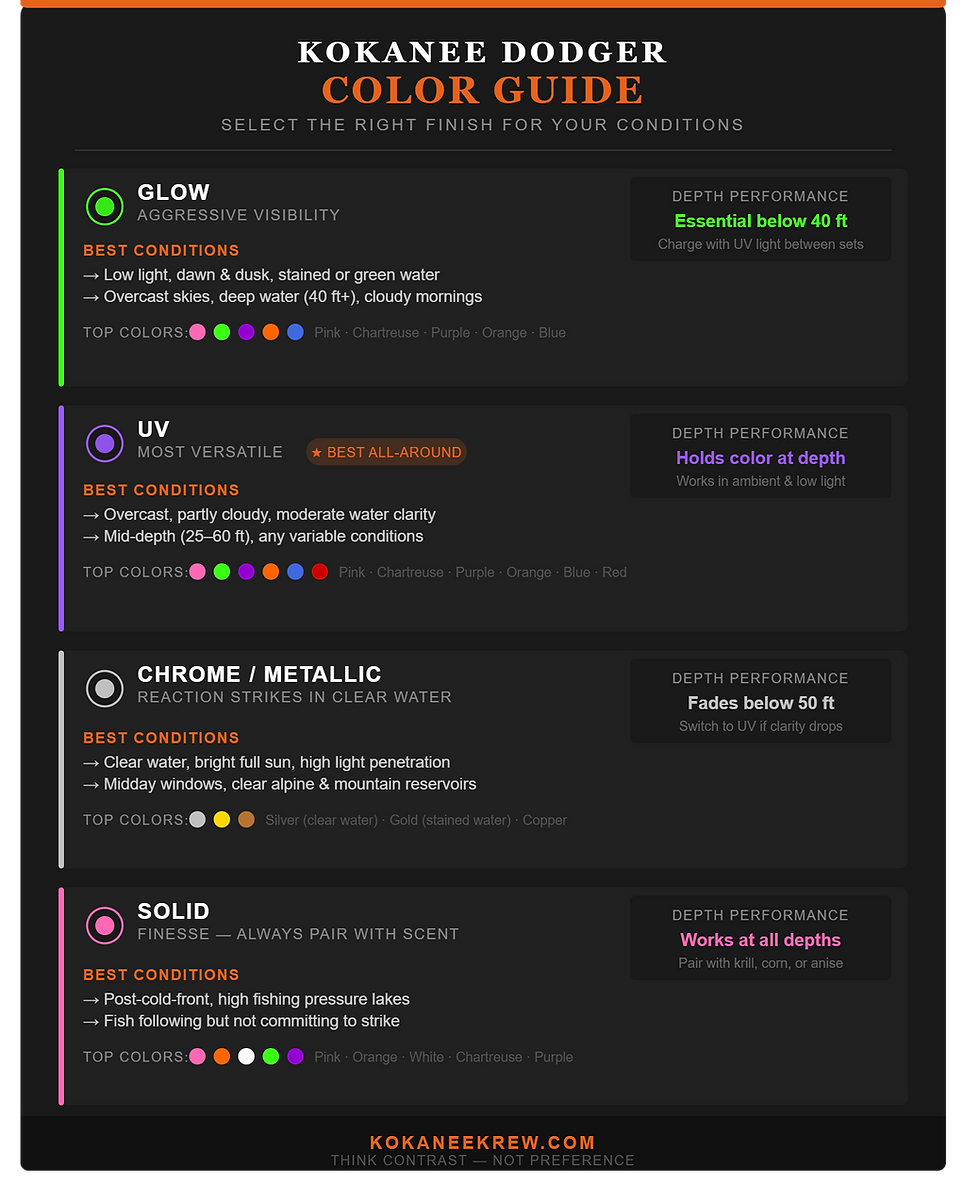
Glow Dodgers
Glow Best for low light, dawn and dusk, stained or green water, overcast skies, and deep water below 40 feet. Glow is essential below 40 ft regardless of surface light conditions — natural light simply doesn't penetrate consistently beyond this depth on most lakes. Charge your glow dodgers with a UV flashlight between sets.
Top colors: Pink, Chartreuse/Green, Purple, Orange, Blue.
UV Dodgers
UV The most versatile option across all conditions. Especially strong in overcast, partly cloudy, and moderate water clarity situations at mid-depth (25–60 ft). UV retains color at depth better than standard paint and activates in ambient light — making it the best "when in doubt" starting choice.
Top colors: Pink, Chartreuse/Green, Purple, Orange, Blue, Red.
Metallic Dodgers
Chrome / Metallic Best for clear water, bright full sun, high light penetration, and midday bite windows on clear alpine reservoirs. Chrome loses effectiveness quickly without strong light and is largely ineffective below 50 ft in average-clarity lakes. Switch to UV or Glow if clarity drops.
Top colors: Silver (clear water), Gold (stained or green-tinted water), Copper.
Solid Color Dodgers
Solid Best for neutral or pressured fish, post-cold-front conditions, high fishing pressure lakes, and situations where fish are following but not committing. Solid colors work at all depths — it's not a depth-dependent choice. Use when fish are conditioned to avoid flash. Always pair with scent.
Top colors: Pink, Orange, White, Chartreuse, Purple.
Kokanee Dodger Speed and Depth Chart
After getting the depth nailed it comes down to Kokanee trolling speed.

Ice-Off / Early Spring Target Depth: 5–25 ft | Speed: 0.8–1.2 mph | Top Dodger: Small Glow Skateboard
Spring Target Depth: 10–40 ft | Speed: 0.9–1.3 mph | Top Dodger: Standard Skateboard or Sling Blade — UV
Early Summer Target Depth: 25–50 ft | Speed: 1.0–1.4 mph | Top Dodger: Standard Sling Blade — UV or Chrome
Peak Summer Target Depth: 40–100 ft | Speed: 1.1–1.6 mph | Top Dodger: Large Sling Blade or Double D — Glow or UV
Fall Transition Target Depth: 40–80 ft | Speed: 1.0–1.4 mph | Top Dodger: Large Solid Oval or Spinner-Dodger + Scent
Important: Changing your trolling speed changes your running depth. Any time you adjust mph, verify you're still in the thermocline before assuming depth is the problem.
How to Choose the Right Kokanee Dodger
Experienced kokanee anglers don't randomly swap dodgers and hope for the best. They eliminate variables one at a time. Here's the exact system:
Step 1 — Match Dodger Size to Depth
Shallow (under 25 ft) → Small Dodger
Mid-Depth (25–50 ft) → Standard Dodger
Deep (50 ft+) → Large Dodger
Step 2 — Match Color to Light Conditions
Low light / dawn / dusk → Glow
Overcast / variable cloud → UV
Bright sun / clear water → Chrome
Post-front / neutral fish → Solid
Step 3 — Match Dodger Style to Fish Behavior
Aggressive / actively chasing → Sling Blade or Chrome
Neutral / following but not biting → Double D + Scent
Lockjaw / not responding → Spinner-Dodger + Scent
Easily spooked in clear water → Teardrop or Oval — Solid
Step 4 — Fine-Tune Continuously
Adjust speed 0.1–0.2 mph at a time
Rotate colors every 20–30 minutes if fish aren't responding
Watch your rod tip — steady pulse is your target
Add scent before assuming fish are absent — they may be neutral, not gone
Note what's working and repeat it
Sling Blade vs. Skateboard Dodger: Which One Wins?
This is one of the most common kokanee dodger questions, so here's the honest answer.
The Sling Blade wins in most summer and mid-season conditions. Its slim profile allows faster trolling speeds, generates a tight wobble that covers water efficiently, and can be fine-tuned by bending. The Standard Pink Sling Blade with a pink or green hoochie is the rig most professional kokanee guides including the KokaneeKrew team reach for first.
The Skateboard wins in early spring when fish are shallow, lethargic, and benefit from the stronger side-to-side kick and higher flash the flat profile produces. It's also the better starting choice for beginners because the action is more obvious and easier to read on the rod tip.
The real answer: keep both on your boat and switch based on depth, fish behavior, and trolling speed. Anglers who commit to only one style leave fish in the water.
Dodger vs. Flasher for Kokanee
A dodger and a flasher are often confused by newer kokanee anglers, but they behave very differently. A dodger wobbles side to side with a controlled action that directly imparts movement to the trailing lure. A flasher rotates 360 degrees, creating a spinning motion and a very different action pattern.
For most kokanee applications, dodgers are preferred. The side-to-side wobble more closely mimics the lateral movement of small baitfish and zooplankton, and the action transfers more naturally to a hoochie, Wedding Ring, or small spoon. Flashers are more common in saltwater fishing where the faster rotation and larger flash signature are advantages.
The Inline Blade Dodger sits in the middle of this spectrum it adds spinner-style rotation to a dodger body, giving you elements of both. It's the best option when water clarity is low and vibration needs to carry the presentation.
Utah Kokanee Guided Trips — KokaneeKrew.com. Fish Strawberry Reservoir, Fish Lake or Jordanelle Reservoir. Full gear provided. All skill levels welcome. Call to Book!
The Biggest Mistake Kokanee Anglers Make
They pick one dodger and never change it. They find something that worked once and run it all day, all season, in every condition. That's why they average one or two fish when they should be limiting out.
Consistent kokanee anglers are constantly adjusting. Here's what that looks like on the water:
Change trolling speed 0.1–0.2 mph every 20 minutes if fish aren't responding
Rotate dodger colors methodically — don't grab a random color, work through a system
Verify your depth every time you change speed
Switch dodger style when fish follow but won't commit — go to Double D or Spinner-Dodger
Add scent before assuming the fish aren't there — they may be neutral, not absent
Run multiple rod configurations simultaneously to test variables faster

Final Verdict: What Is the Best Kokanee Dodger?
The real answer: the best kokanee dodger is the one matched to the conditions. But when you need a starting point that will catch fish almost anywhere in the West, here's the setup the KokaneeKrew uses as a baseline before adjusting:
Go-To Starting Setup:
Dodger Style: Standard Sling Blade
Color: UV Pink or Chartreuse
Trolling Speed: 1.2–1.4 mph
Depth: Match the thermocline (50–55°F zone)
Scent: Krill or Corn
Start here. Watch your rod tip. Give it 20–30 minutes. If fish show on sonar but aren't biting, add scent. If there are no marks, adjust depth. If marks are there and fish still aren't biting, try a Double D in the same color. The system works you just have to run it.
Ready to catch more kokanee? Fish with KokaneeKrew for Guided trips on Strawberry Reservoir, Fish Lake and Jordanelle Reservoir, Full gear provided. All skill levels welcome.


Comments